
Functional lipids for food formulation I Clean label goals
Alianza is a lipid ingredient supplier with commercial presence in 23+ countries and production in the USA, Mexico, Chile, and Colombia.
We work with food manufacturers across bakery, chocolate, spreads, frozen desserts, sauces, functional foods, and specialized nutrition to evaluate fat and oil systems that support taste, texture, stability, processing performance, supply consistency, and clean-label goals. We start with the product challenge not just the ingredient.
Alianza is a lipid ingredient supplier with commercial presence in 23+ countries and production in the USA, Mexico, Chile, and Colombia.
We work with food manufacturers across bakery, chocolate, spreads, frozen desserts, sauces, functional foods, and specialized nutrition to evaluate fat and oil systems that support taste, texture, stability, processing performance, supply consistency, and clean-label goals. We start with the product challenge not just the ingredient.

Alianza helps food manufacturers explore lipid-based formulation strategies designed to support taste, texture, nutrition, stability, processing performance, supply consistency, and clean-label objectives.
Alianza is not a commodity ingredient distributor. It is a formulation ally for food brands and manufacturers that need their fat system to perform across reformulation, clean label, nutrition, and supply objectives.
Food formulation is becoming increasingly complex as brands respond to cleaner-label expectations, evolving regulatory discussions, ingredient cost pressure, supply variability, and changing consumer preferences. In the United States, reformulation priorities are often connected to color, sodium, added sugar, saturated fat, and overall ingredient perception.
The FDA and HHS have announced actions to work with the food industry on moving away from selected petroleum-based synthetic dyes toward natural alternatives, while the FDA has also issued voluntary sodium reduction goals for commercially processed, packaged, and prepared foods. The updated “healthy” nutrient content claim also considers limits for saturated fat, sodium, and added sugars.
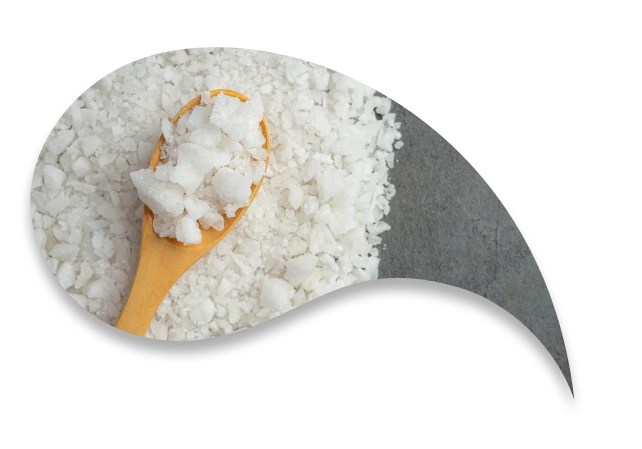
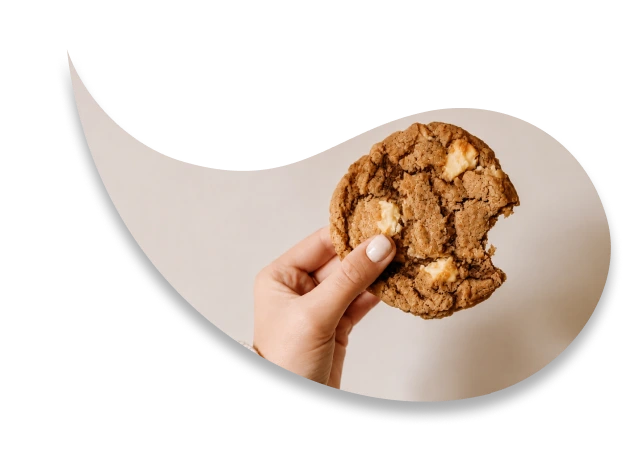
For manufacturers, these challenges rarely involve a one-to-one ingredient change. Adjusting color may affect visual appeal; reducing sodium may influence flavor perception; changing the fat system may affect texture, mouthfeel, structure, spreadability, melt, or stability. In this context, functional lipids can be evaluated as part of a broader formulation strategy to help brands balance product performance, consumer expectations, cleaner-label goals, operational needs, and commercial feasibility.
Alianza works across seven food manufacturing categories, each with distinct formulation challenges that a lipid-based strategy can help address.
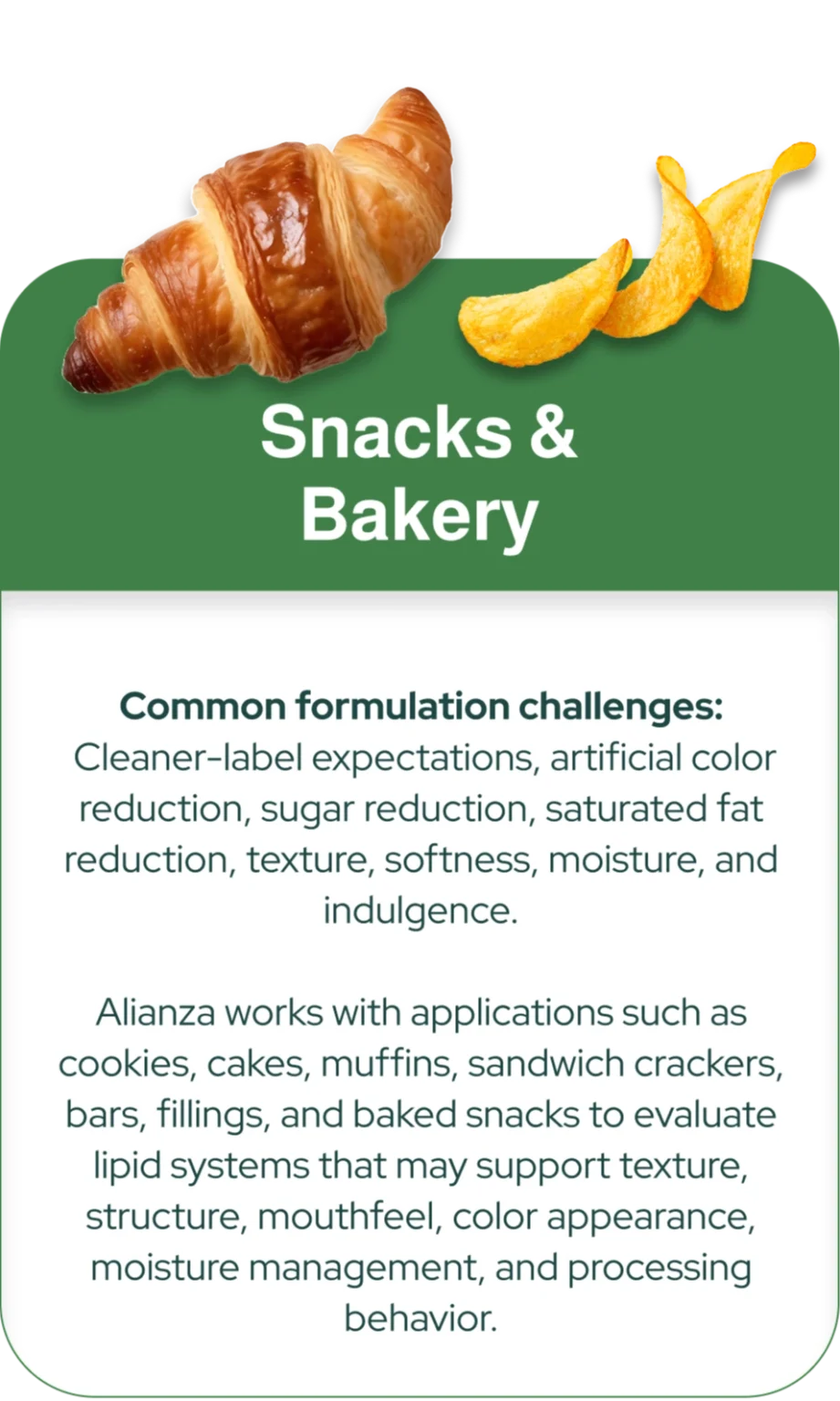
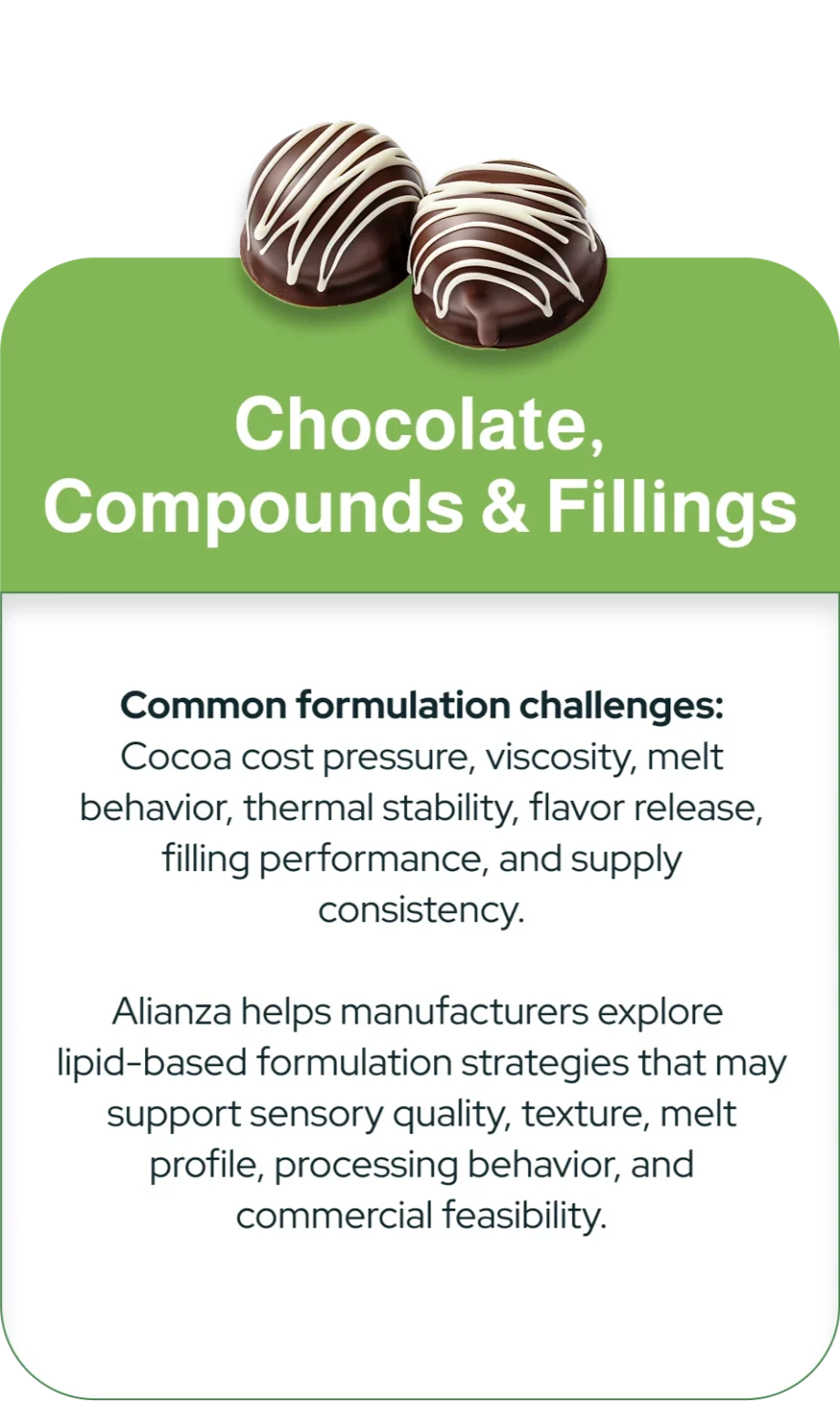
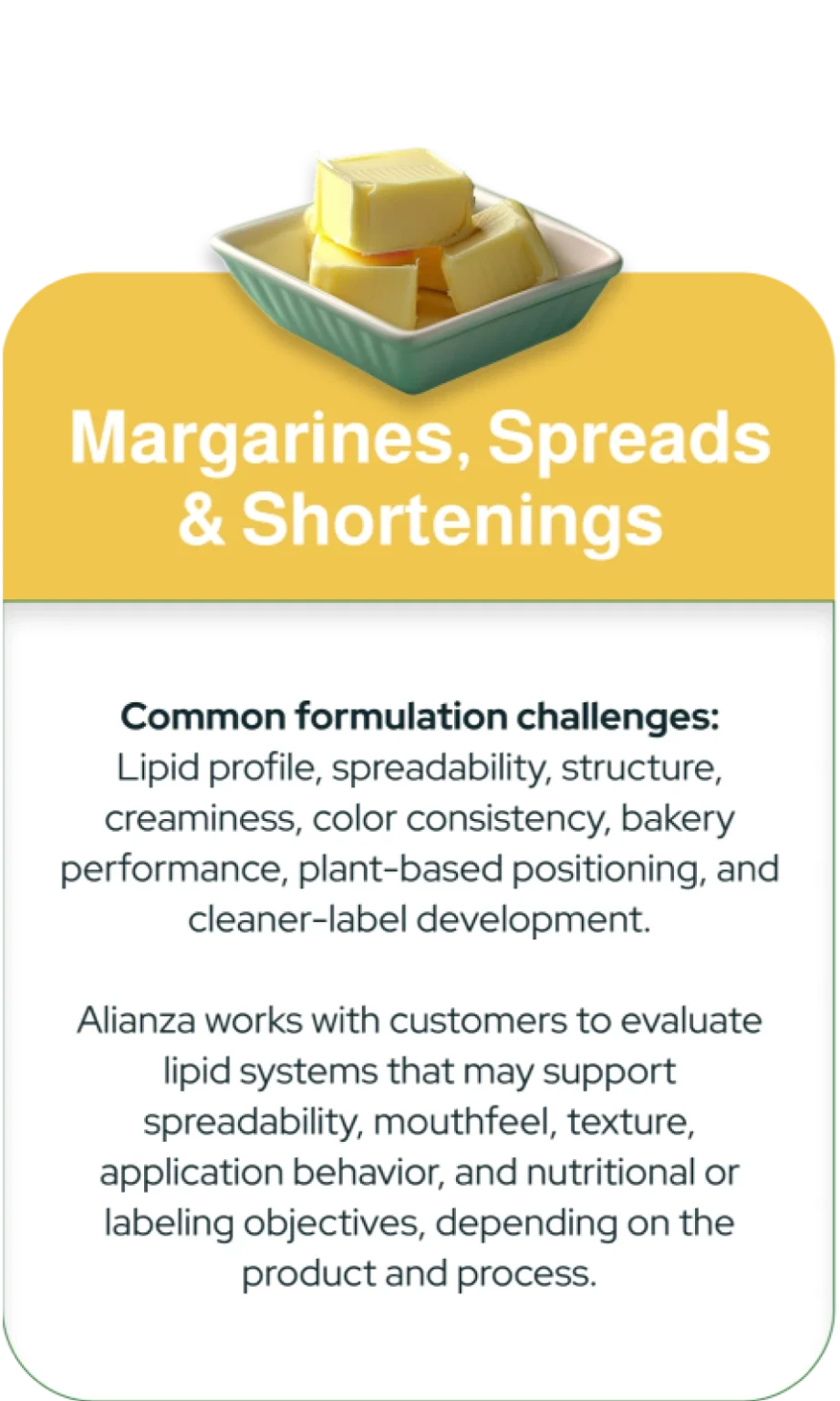
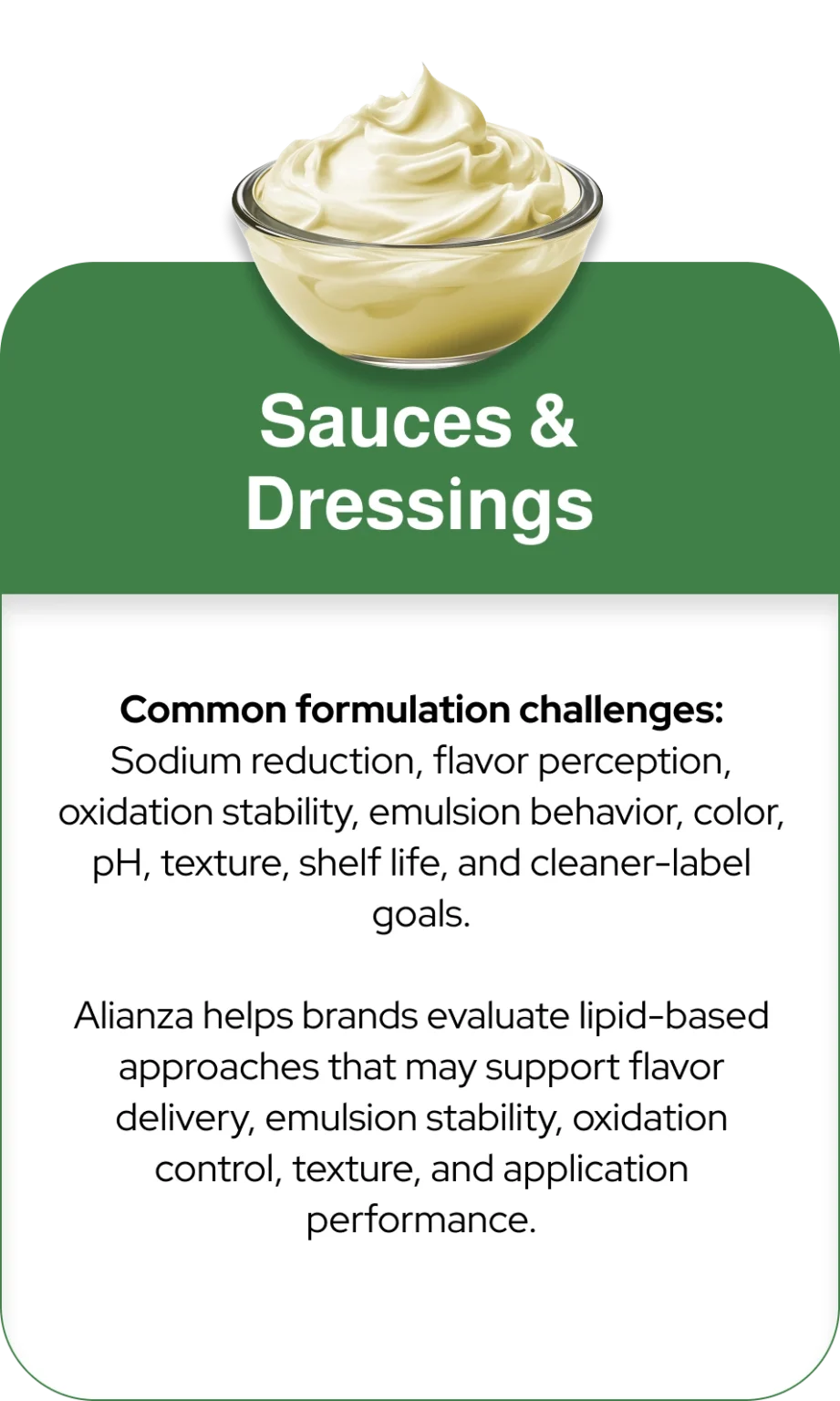
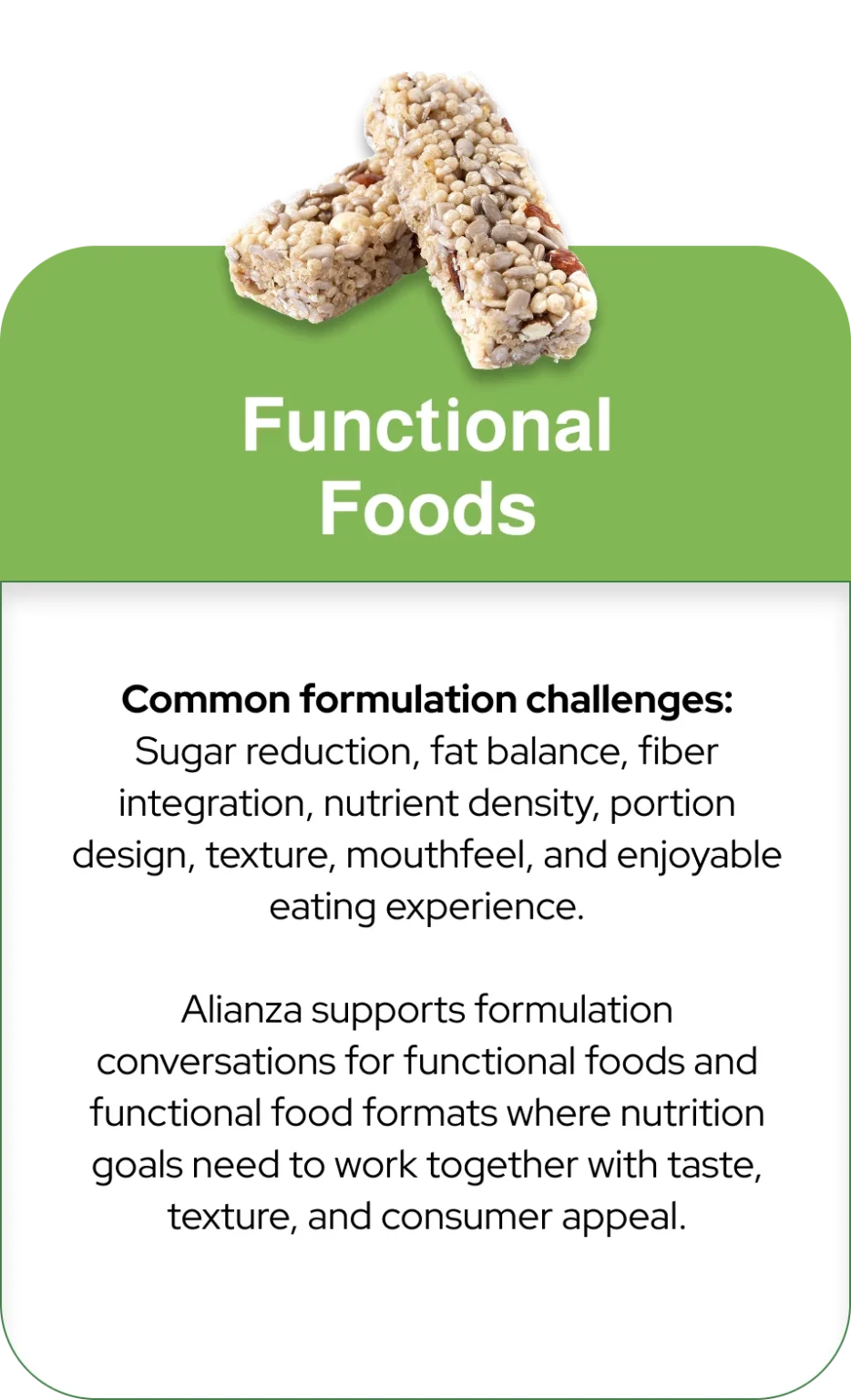
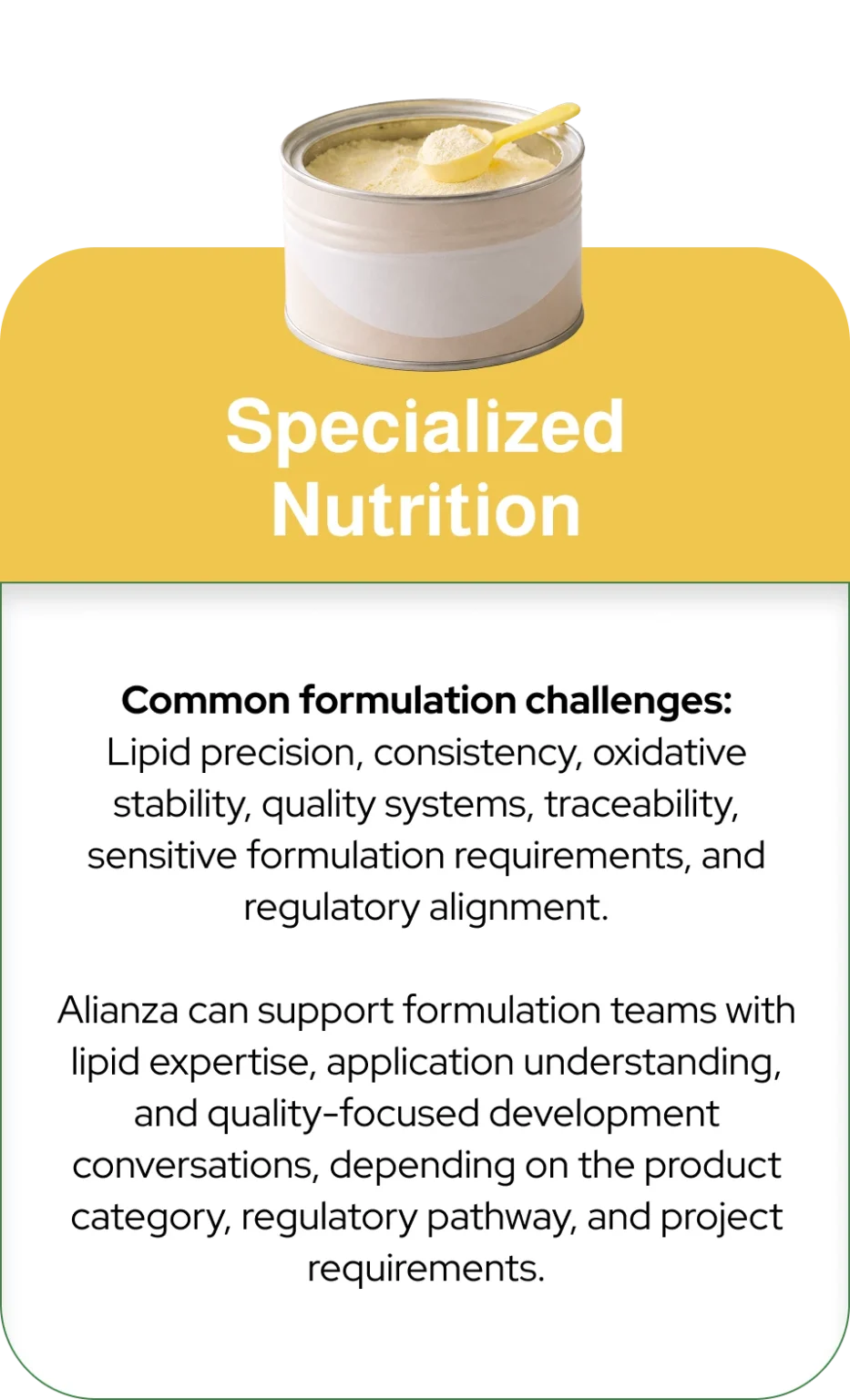
Explore our application areas.
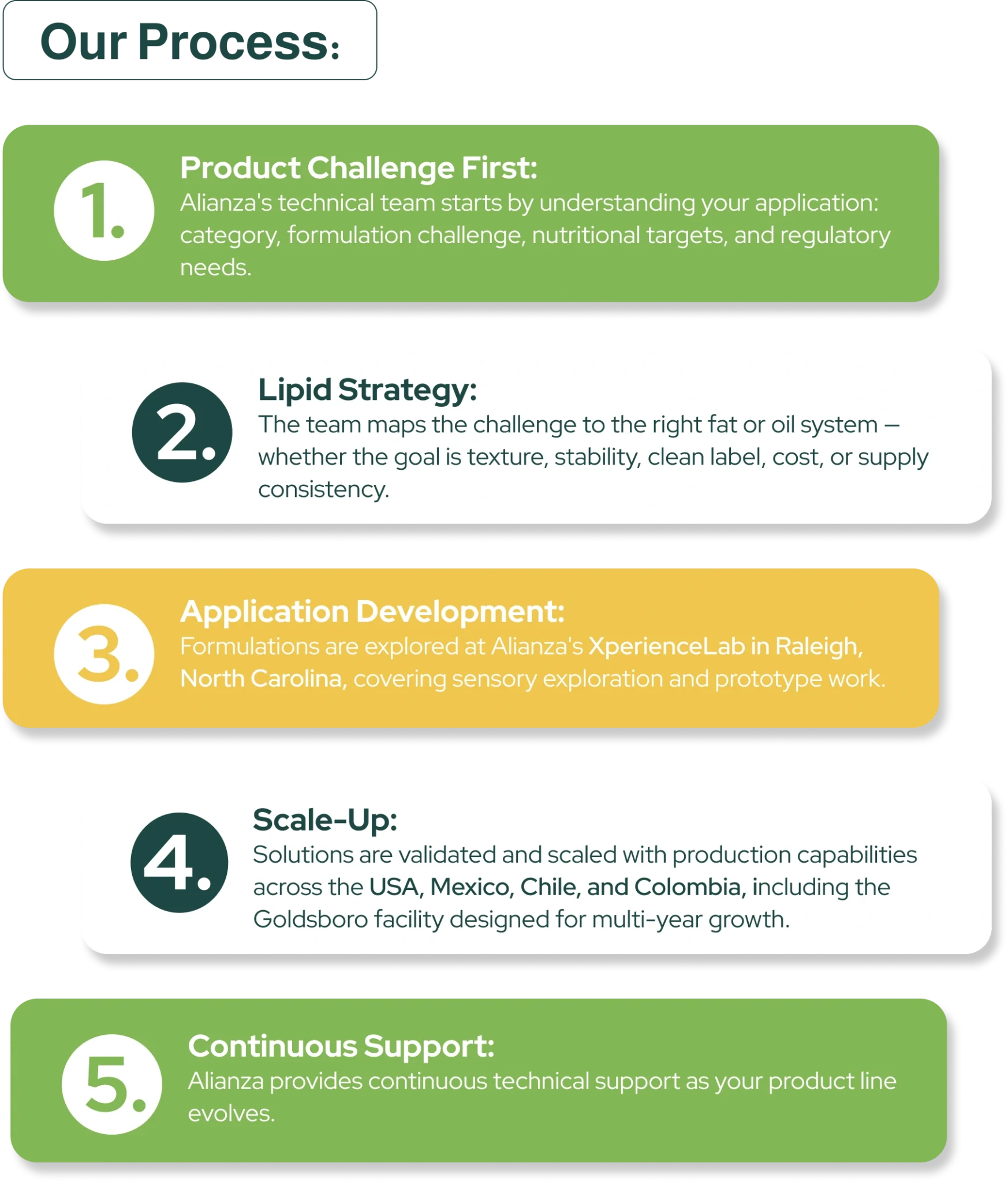
Alianza works with a category-first approach: we begin with the product challenge, not only the ingredient.
A cookie may change structure when sugar is reduced. A dressing may need flavor support when sodium is lowered. A frozen coating may require a specific fat behavior to support snap and gloss. A chocolate filling may be affected by cocoa cost, viscosity, melt, or supply variability.

of commercial presence not a regional distributor
USA, Mexico, Chile, Colombia with supply redundancy built in.
designed to support
multi-year growth in the US market
dedicated to formulation thinking, sensory exploration, and application development
solutions are built around the product challenge, not around available inventory
supply planning processes designed to impact disruption risks
Tell us what you are trying to achieve, and our team will help you explore a lipid solution aligned with your product category, application, processing needs, and business goals
Explore our application areas.
Beyond supplying ingredients, Alianza works with customers to explore ways to support product performance, consistency, supply planning, cost optimization, and speed to market through technical support and application-focused solutions.
Alianza can work with your team to evaluate opportunities related to formulation, fat systems, ingredient selection, process efficiency, or waste reduction. Any potential changes would need to be assessed according to your specific product, process, quality requirements, and business objectives.
Alianza’s solutions are developed around specific applications and customer needs. Depending on the project, we can help evaluate functionality related to texture, stability, flavor release, shelf life, and processing efficiency.
Alianza’s application experts can help customize fat systems that may support creaminess, crunch, softness, spreadability, or other sensory attributes depending on your product goals, formulation, and process.
Through formulation evaluation and optimized fat composition, Alianza can help explore ways to support oxidation resistance, product stability, and quality over time, depending on the application and validation requirements.
Alianza works with responsible sourcing programs and sustainability initiatives that can help customers address environmental and corporate responsibility goals while maintaining focus on product performance and supply needs.
Yes. Alianza offers palm-free alternatives for selected applications. Our team can help evaluate these options according to your formulation, labeling, performance, sourcing, and regulatory requirements.
Yes. Alianza has trans fat-free solutions that can be evaluated to help deliver similar functionality while supporting current regulatory and consumer expectations.
Alianza works with customers to evaluate lipid-based formulation approaches that may support cleaner-label objectives. Final label claims and product attributes depend on the complete formulation, processing conditions, ingredient declaration, and applicable regulatory requirements.
Alianza leverages diversified sourcing, manufacturing capabilities across four countries, and supply planning processes to support reliable supply and help reduce disruption risks where possible.
SOURCES FOR WEB PAGE
[1] U.S. Food and Drug Administration. (2025, April 22). HHS, FDA to phase out petroleum-based synthetic dyes in nation’s food supply.
[2] U.S. Food and Drug Administration. (2021, October). Guidance for industry: Voluntary sodium reduction goals: Target mean and upper bound concentrations for sodium in commercially processed, packaged, and prepared foods.
[3] U.S. Food and Drug Administration. (2025, February 24). FDA finalizes updated “healthy” nutrient content claim.
[4] International Food Information Council. (2025). 2025 IFIC Food & Health Survey: A focus on food and ingredient safety.
https://ific.org/research/2025-ific-food-health-survey/
[5] Rios, R. V., Pessanha, M. D. F., Almeida, P. F., Viana, C. L., & Lannes, S. C. S. (2014). Application of fats in some food products. Food Science and Technology, 34(1), 3–15.
https://www.scielo.br/j/cta/a/dGjsjmWPp9nJtwSJxYvTFMf/?format=pdf&lang=en