The Shift Away from Artificial Dyes: A Natural Path for Snack Innovation
The snack industry is undergoing a significant transformation. As consumer expectations evolve and global regulations tighten around synthetic additives, many of the leading players are accelerating their transition toward clean-label solutions, particularly in the realm of colorants.
Today’s consumers are increasingly informed and selective about the ingredients in their food. Artificial and fungal-based dyes long used to impart vibrant hues in extruded snacks, cereals, and coated treats are now facing scrutiny for their potential health risks, controversial origins, and regulatory limitations. Clean-label is no longer a trend but a market standard, pushing R&D departments to revisit long-established formulations.
Governments across regions, including the EU and parts of Latin America, are reinforcing these demands with stricter labeling laws and additive bans. As a result, manufacturers are under growing pressure to reformulate without compromising product quality, shelf appeal, or production efficiency. This creates a complex balancing act between visual impact, sensory performance, regulatory compliance, and cost management.
The Technical Challenge of Replacing Artificial Colorants
Artificial dyes have traditionally been favored not only for their vibrancy and color stability but also for their ease of use in industrial-scale operations. However, replacing them with natural options poses a number of formulation challenges particularly in extruded snack matrices, where high temperatures, variable pH, and fat interactions can compromise the integrity and uniformity of the color.
Colorants derived from fruits, vegetables, or microbial fermentation often present issues with thermal degradation, migration, or incompatibility with existing process systems. Moreover, some natural dyes require higher usage levels to achieve similar visual intensity, which can increase formulation costs and affect texture or flavor.
This is where lipid-based delivery systems present a breakthrough. By integrating color within the fat matrix itself, formulators can not only stabilize the pigment but also enhance its dispersion and adhesion in complex applications like extruded snacks, fried products, and coatings
MirrorColor: Clean-Label Functionality That Performs
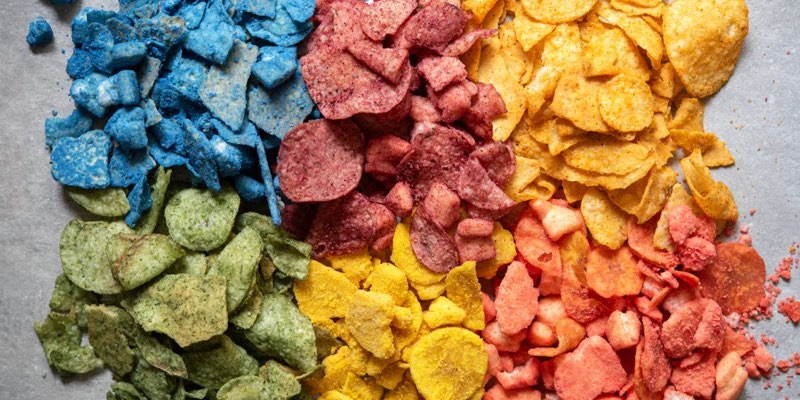
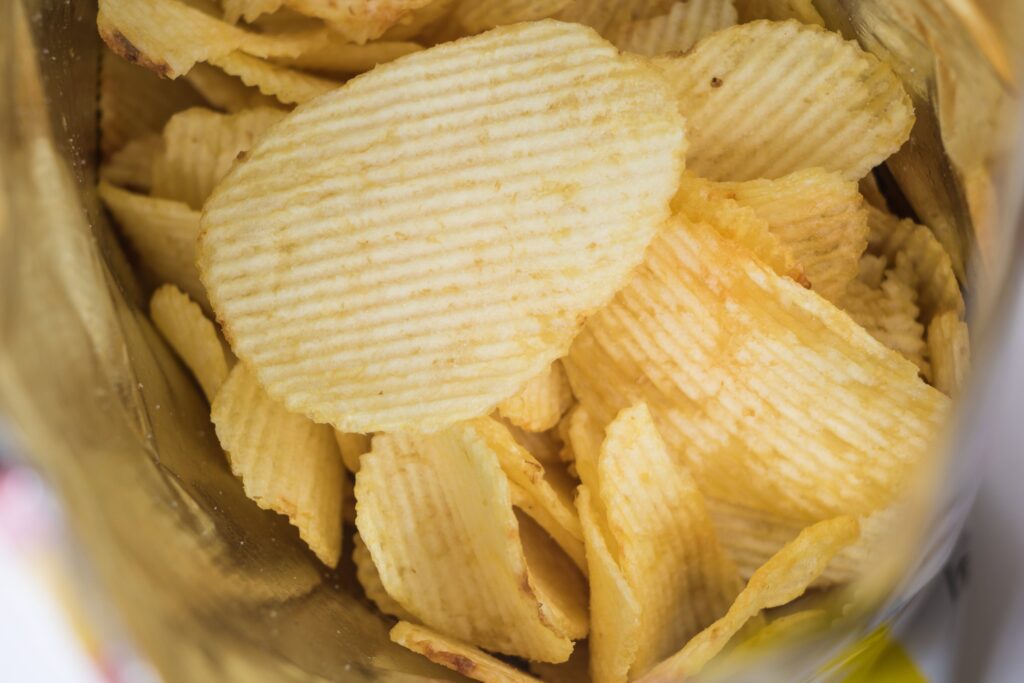
In response to this growing need, MirrorColor has emerged as a powerful tool for color innovation in snacks. It is a clean-label, vegetable-based lipid technology specifically designed to replace yellow and orange tones in extruded snack applications two of the most commonly used hues in products aimed at children or mainstream markets.
Unlike traditional colorants, MirrorColor is thermostable, retaining visual integrity under high-temperature extrusion or frying processes. Its superior wetting properties ensure even dispersion across particles, eliminating streaking or clumping. Additionally, it avoids the waxy or greasy mouthfeel sometimes associated with other fat-based alternatives, preserving the expected crunch and flavor experience.
MirrorColor functions as a 1:1 drop-in solution in slurry seasoning systems, simplifying the transition for manufacturers and reducing formulation risks. Because it integrates directly into the lipid phase, it also requires no label declaration, helping brands meet transparency goals without overwhelming ingredient lists.
For companies working with palm-based systems, MirrorColor is available with RSPO certification, aligning with global sustainability goals and ethical sourcing policies. This makes it particularly relevant for snack brands looking to reduce environmental impact while maintaining cost and performance standards.
A Forward-Looking Path for Snack Innovation
As the industry continues to pivot toward natural and sustainable options, innovations like MirrorColor represent a new path forward one that balances visual appeal, sensory performance, and operational practicality.
By addressing the challenges of color stability, application efficiency, and consumer transparency, MirrorColor empowers snack manufacturers to reformulate confidently, anticipate regulatory change, and enhance brand credibility. In a category where visual impact drives trial and repeat purchase, solutions like this allow innovation teams to lead with both creativity and responsibility.
Revolutionizing Plant-Based Meat Alternatives: The Game-Changing Impact of MirrorTissue
Mirror Tissue is revolutionizing plant-based meat by replicating the texture and taste of animal fat, enhancing the authenticity of plant-based products. This innovation meets growing consumer demand for high-quality meat alternatives.
How tailored lipid solutions can overcome the production challenges of dairy analogs
Zero deforestation is a priority objective for companies that seek to be leaders in their category and that seek to contribute positively to the planet and communities.
MOSH and MOAH Control: Ensuring Food Safety through High-Impact Strategies
Zero deforestation is a priority objective for companies that seek to be leaders in their category and that seek to contribute positively to the planet and communities.
Trends in the consumption of functional drinks and infant formulas in the United States
Lipids play a significant role in functional beverages by providing palatability and texture, making them appealing to consumers. Learn more about our innovations for this category.
Is it possible to impact sodium and saturated fats through lipids?
At Alianza Team, we develop lipid technologies that may impact the amount of sodium and saturated fat content in products such as chips, snacks, dips, laminated bakery, and more.